Prepare your cell suspension
Start with your sample, research question and the conditions you want to explore.
Explore label-free counting, viability and membrane analysis with microfluidic impedance spectroscopy.
Discuss your application
Start with your sample, research question and the conditions you want to explore.
Bring your chip geometry, flow requirements and available equipment into the discussion.
Check connections, sample preparation and the relevant protocol before running.
Review your data and refine the next experiment with support from the team.
An overview for planning. Use the product-specific protocols for operation.
Product selection depends on your experiment and compatibility requirements.
Find application material, technical guides and support.
Read the published background, setup diagrams and protocols on the original Cellix site.
Inish Solutions for Label-free Cell Analysis
Cell Counting & Viability
Simple Cell Analysis
For a vast range of applications in cell biology: therapeutic applications, stem cell research, cancer cell research, cell toxicology, veterinary applications and quality control
Transfection Efficiencies
Find the Best Cells
Following electroporation, Inish solutions predict your transfection efficiences before you go to the hassle of plating your cells - saving you time and improving your workflow.
What's in a name?
We chose the name Inish for this range of cell analysis solutions because
"Inis"
is the Gaelic or Irish word for:
"island"
and
"tell"
(to tell a story) or
"report"
Since we're based in Ireland, we thought this was quite apt and since every sample tells a story...it seemed the perfect fit for our new range of cell analysis solutions.
Primary T-cells
CAR T-cell therapy
Cell counting and Viability of primary T-cells for CAR T-cell manufacturing.
Cell lines
Life Science R&D
Cell Viability is particularly important for R&D applications including testing drug metabolism and cytotoxicity.
Tr
ansfection Efficiency of cell lines for biomanufacturing of biologics, including vaccine & antibody production and synthesis of therapeutic proteins.
Stem cells
Stem Cell Therapy
Quality control of stem cells for applications including tissue regeneration or stem cell therapy for blood disorders, cardiovascular and brain diseases
Yeast cells
Biologics
Reliable Cell Counting & Viability results every time. Yeast cells are a popular choice in biologics for the manufacture of cell products - they have numerous advantages including fast growth and the ability to easily manipulate their genetics
Applications
Label-Free: What does it mean?
No fluorescent dyes/stains or magnetic beads are required to "label" your cells for analysis. This removes a step in your workflow and saves you money on reagents. It also leaves your cells in their native state for analysis. So, how do we actually analyse your cells? We use a method called impedance
spectroscopy. Unlike classic fluorescence flow cytometry, magnetic cytometry or imaging microscopy; this method does does not require labels (i.e. dyes, stains or beads) for simple cell analysis.
Impedance: What is it and how does it work?
Impedance spectroscopy is a method of measuring the resistance and capacitance properties of a cell or particle by applying an electric field across two electrodes embedded in a microfluidic chip.
As each cell flows past the electrodes, the electric field is disturbed.
Impedance has been around for a long time and most famously used in the classic Coulter Counters. However, these devices were largely used for simple counting and sizing of cells and particles. They typically used low frequency impedance measurements and thus were unable to differentiate one cell from another. Now, with advanced electronics, we can measure several frequencies simultaneously - this enables us to determine different parameters of a single cell. And by combining all of this with microfluidics, we can control the position and orientation of cells as they pass the electrodes. This provides a more precise measurement of the cells' parameters.
Depending on the frequency, we can determine different parameters of the cell:
Cell or particle size
Membrane integrity
Cytoplasm content
Vacuole content
Single Cell Analysis
Using the method of impedance spectroscopy, every single cell is analysed as it passes the electrodes. This results in a true "
single cell analysis"
technique where results are reported in standard FCS file format: every dot on the scatterplot represents a single cell.
Impedance Spectroscopy for Cell Counting and Viability
Impedance Spectroscopy for improving Transfection Efficiencies
Impedance Spectroscopy for Cell Counting and Viability
How does it work?
Label-Free
Impedance
Single Cell Analysis
Our annual Christmas Sale is back - Check it out before it’s over!
Cellix Technical Team
Nov 28, 2022
2 min read
Inish Analyser Data Transfer Protocol
Cellix Technical Team
Nov 7, 2022
3 min read
How to analyse data using the Inish Analyser?
Cellix Technical Team
Oct 17, 2022
3 min read
Related Blogs
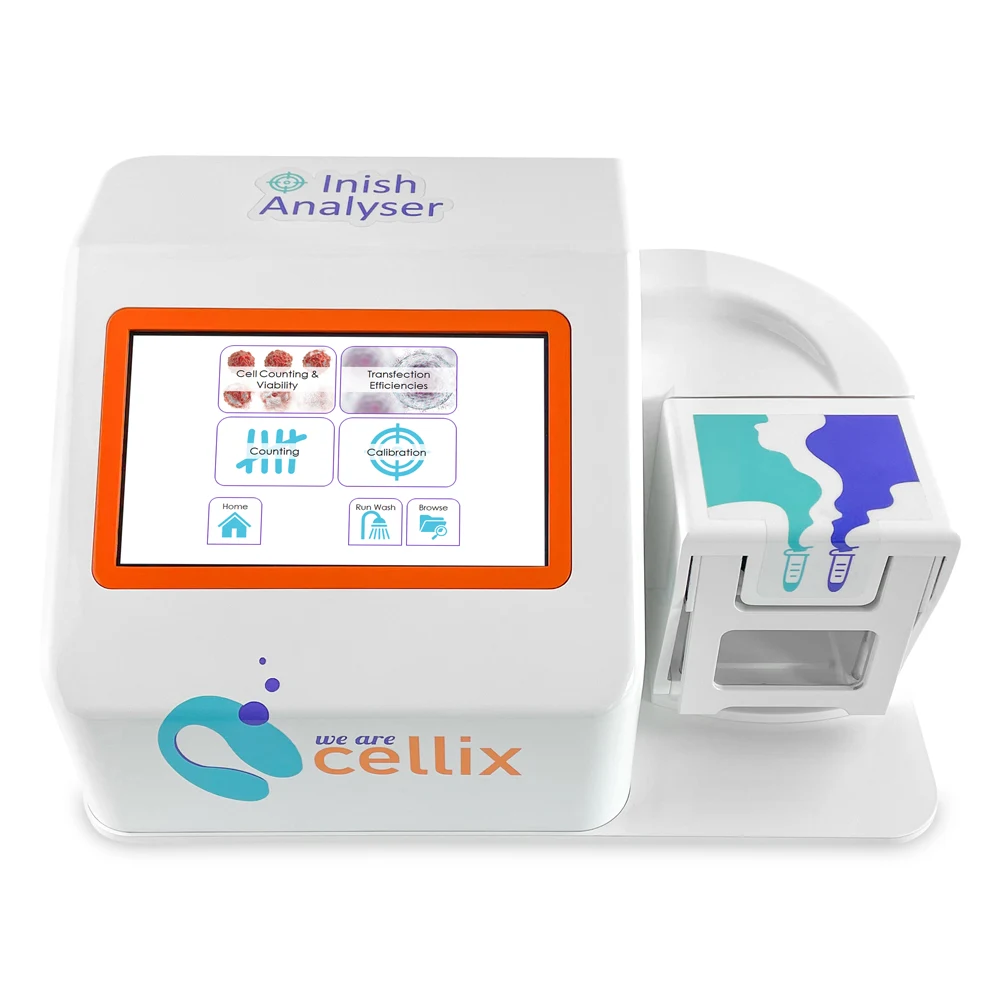
Inish Analyser
Inish Calibration Kit
Sample & Waste Tubes
Inish Analyser Buffer
Inish Cleaning Fluid
Recommended Products
Get a Quote or more information
Tell us what you’re exploring. We’ll help you find your flow.