Characterise your sample
Start with your sample, research question and the conditions you want to explore.
Match your chip, pump, sample and protocol for mixing, hydrodynamic focusing and microfluidic experiments.
Discuss your application
Start with your sample, research question and the conditions you want to explore.
Bring your chip geometry, flow requirements and available equipment into the discussion.
Check connections, sample preparation and the relevant protocol before running.
Review your data and refine the next experiment with support from the team.
An overview for planning. Use the product-specific protocols for operation.
Product selection depends on your experiment and compatibility requirements.
Find application material, technical guides and support.
Read the published background, setup diagrams and protocols on the original Cellix site.
Microfluidic Solutions
Microfluidics is the study of very small volumes of fluid, and in particular, focuses on how we control and manipulate fluid samples. These fluid samples may vary in their viscosity or they may contain cells, particles or analytes. Applications for microfluidics have grown substantially in the past 20 years, ranging from millions of reactions being performed in individual droplets (via droplet generation techniques) to cells being grown on-chip with a view to creating
"organs-on-chip"
thereby helping pharma and biotech companies more quickly assess drug candidates. The possibilities are growing and Cellix is providing solutions aiding researchers' experimental set-up.
Droplet Generation
Uniform, Stable Droplets
Reliable, steady flow rate and reproducible, consistent volume-size of droplets.
Precise Liquid Control
Hydrodynamic Focusing
Hydrodynamic focusing and precise multichannel mixing are just some of the applications required for the development of your assays...
Organ-on-Chip
Cell culture on-chip
Microfluidic solutions which enable the culture of cells on-chip mimicking some of the key functions of a living organ.
Volatile Organic Compounds
Analysis made easy
Microfluidic solutions for simple VOC sample preparation and analysis.
Applications
Microfluidic Chip
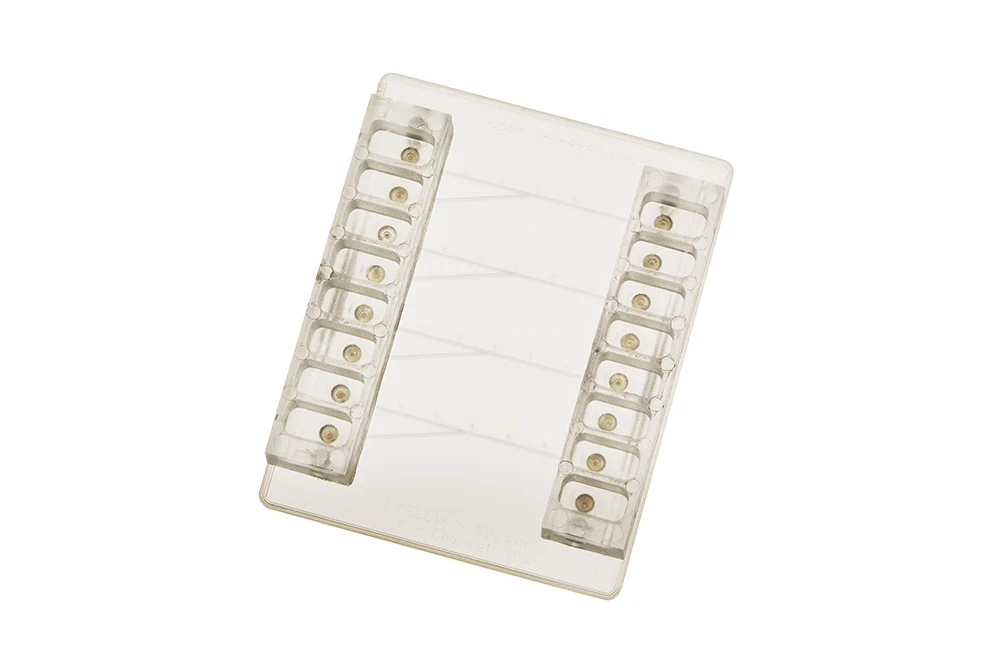
Microfluidic chips are typically fabricated in plastic, glass or PDMS (PolyDimethylSiloxane) and contain a wide variety of simple to complex geometries: single microchannels or multiple intersecting microchannels with varying dimensions. Such geometries facilitate mixing, pumping and sorting of samples, cell growth, cell and particle encapsulation etc. There are many more designs and applications which can be developed but
your choice of microfluidic chip
(material type, channel geometries, channel dimensions etc.) is crucial to your experimental set-up. When making your own chip or purchasing a chip, it is important to consider the
material type
as this will offer different capabilities.
Many researchers have the capability to fabricate chips in their own labs and usually PDMS is the material of choice because it is quick, easy to fabricate and low-cost. However, PDMS has a number of well-known disadvantages and as a result, plastic chips are gaining in popularity, particularly as material properties have improved in recent years offering greater optical quality and multi-layer bonding. Glass chips are more difficult to fabricate and thus, they are often only produced by specialist companies.
Check out our table below
for a summary of some of the key properties for different material types.
Microfluidic Chip
How does it work?
Table - Chip Material Types
Parameter / Material Type
Plastic
Glass
Fabrication Difficulty
Easy: Photolithography or machining of moulds with PDMS chips cast and cured on these moulds
Easy - Medium: Thermomoulding or photolithography
Difficult: Photolithography or wet/dry etching typically by specialist companies
Fabrication Cost
Extremely Low
Low - Medium
High
Multi-layer channels (bonding)
Easy: Bonds easily to glass or PDMS substrates
Easy - Medium
Difficult: Requires high temperature & pressure and extremely clean surfaces.
Smallest Channel Size
<1 um
~100 nm
<100 nm
Optical Transparency
High
High
Extremely High
Thermal Stability
Medium
Medium - High
Very High
Solvent Compatibility
Low
Medium - High
Very High
Permeability to Oxygen
Extremely High: Good for gas transport for cellular studies (e.g. cell culture) but bubble formation causes problems with experiments.
Low
Extremely Low
Hydrophobicity
Hydrophobic: Non-specific adsorption and permeation of macromolecules (e.g. proteins) can cause problems.
Plasma treatment possible but typically lasts short time.
Hydrophobic: Plasma treatment possible and can last several years.
Hydrophilic
Pump - choosing the right one
For many years, syringe pumps were the only option for microfluidics and most papers cited use of Harvard Apparatus or KD Scientific syringe pumps. The market has since developed and there are now many different types of microfluidic pumps to choose from:
Peristaltic pumps
Standard syringe pumps
Microfluidic syringe pumps
Pressure pumps
Recirculation pumps
Each type of pump has pros and cons so it is important to consider the following to help you
choose the right pump for your application
What type of microfluidic chip are you connecting the pump to?
The geometry and channel dimensions of your microfluidic chip will offer different fluidic resistances and this needs to be taken into account before choosing your pump.
What flow rates do you wish to use?
What is the viscosity of your sample?
Blood is much more viscous than water and this can impact flow rates in microfluidic channels.
Do you require a flow sensor?
Flow sensors provide active feedback maintaining accurate and stable flow control. However, these are typically calibrated for water or oil and are not compatible with blood.
Check out our table below
for a summary of some of the key properties for different microfluidic pumps including what Cellix can offer.
Parameter / Pump Type
Peristaltic
Standard Syringe
Microfluidic Syringe
Pressure
Recirculating
Technology
Peristaltic
Stepper motor
Stepper motor with damper
Pressure
Solenoid
Flow Stability
Low
High
Extremely High
Extremely High
Medium
Flow Rates
uL/min - L/min. Low - High.
pL/min - mL/min. Low.
Limited by syringe size.
High flow rates difficult to achieve - syringe refilled manually.
nL/min - mL/min. Low - High. High flow rates achieved with optional manifold - refills syringe automatically.
uL/min - mL/min. Low - High
uL/min
Low, Pulsatile
Flow Control
Yes (calibration required)
Yes
Yes (flow sensor for ExiGo optional)
Yes
(with flow sensor)
No
Pressure Control
No
No
No
Yes
No
Switching Response Time
High
Low
Extremely High
Extremely High
Medium
Cell Samples
Yes (cell damage likely with squeezing of tubing)
Yes
Yes
Yes
Yes
Blood Samples
No
Yes
Yes (without flow sensor)
No
No
Gas Sample
No
No
No
Yes
No
Fluid Recirculation
No
No
Yes (possible with optional manifold with ExiGo pump)
No
No
Pump
Table - Pump Types
Application
In addition to choosing the right microfluidic chip and pump, you must also take your application into consideration. Here are some tips and examples of things you need to think about:
Cell sample type?
Pump flow sensors are not compatible with whole blood samples as they are not calibrated for the viscosity of blood. There are also issues with build-up of cellular debris from blood on the sensors themselves. So, if blood is your sample, you need to choose a microfluidic pump which can deliver the flow rates you require
without the need for a flow sensor
Sample concentration?
With high concentration of samples (cells or particles) you may risk having blockages in the microchannels of your chip. Here you must be careful to choose a chip with channel sizes which are large enough to handle high concentrations; or if this is not possible, you must dilute your cell sample. Depending on your sample concentration, you must also consider the risk of sedimentation. If your flow rate is too low, you may have issues of sedimentation in your sample reservoir. If you're not sure and you'd like advice on this, please
contact us
Choice of tubing?
Connecting the macro-world to the micro-world is a challenge and you must try to minimise rapid changes in cross-section. For example, when the tubing is connected to the channel of your chip; if the tubing inner diameter (ID) is very large compared with the dimensions/size of the channel of the chip, there will be a high pressure drop at the connection point (tubing-to-chip) resulting in sample sedimentation and blockages.
Application
Protocol
You've spent some of your valuable budget purchasing microfluidic chips and a microfluidic pump for your application. You took the time to carefully compare all the microfluidic chips and pumps on the market before you made your purchase, ensuring that it meets all the technical requirements for your application. Your purchase arrived all shiny and new and you set it up in your lab and then you find
it's not working!
This is a frustrating situation for researchers and Cellix's team works hard to ensure that our customers avoid some common mistakes.
Assay protocol is just as important as all the features and benefits of your new microfluidic chip or pump. Here are some of the key points to consider relating to protocols for microfluidics:
Priming the channels of the microfluidic chip:
Everyone in microfluidics knows that bubbles in a microfluidic chip can ruin their experiment. Priming channels correctly is key to avoiding this issue. Cellix's pump-to-chip
tubing connections
are easily primed and plug directly into our chips. If you're using your own chip, we can offer advice on best methods.
Order of sample-buffer-sheath fluid injection into the microfluidic chip:
The order of injection of your different fluids (sample, buffer or sheath) is really important depending on what you are trying to achieve. This must be done in the correct order to achieve your desired results.
Step-by-step assay advice:
For common applications, Cellix provides protocols for experimental set-ups
. If you don't see your application or protocol listed in our
Resource section
, we can offer advice on how your protocol could be developed.
Cellix's Team has >20 years experience in microfluidics and we have worked with researchers all over the world, assiting them in their experimental set-ups. If you have a questions,
get in touch now
Protocol
4U Pump: Simple steps to connect 4U pump to the sample reservoir and flow sensor
Cellix Technical Team
Apr 18, 2024
2 min read
How to get started with your Mirus Evo 8-channel Pulse-Free Microfluidic Syringe Pump and Multiflow8
Cellix Technical Team
Feb 20, 2024
3 min read
A Self-Sealing Modular Microfluidic System Using PDMS Blocks with Magnetic Connections -By Ecker et al., 2023.
cellixmarketing
Feb 12, 2024
2 min read
Related Blogs
Related Publications
Microfluidic Pumps
Microfluidic Chips
Pump Accessories
Tubing & Connectors
Recommended Products
Microfluidic Solutions query
Get a Quote or more information
Tell us what you’re exploring. We’ll help you find your flow.